
How to Check Criminal History in Slaughter
Start with the office that created the item. Slaughter Police Department is the first stop for a town incident or arrest report. A municipal citation or Mayor's Court disposition belongs with the town court channel. A custodial arrest generally creates a separate East Feliciana Parish Jail record, while a felony or other state-law prosecution becomes a file at the 20th Judicial District Court clerk. The Louisiana State Police Bureau of Criminal Identification and Information, or BCII, provides fingerprint-based Right to Review for a person's own statewide record.
- Ask Slaughter Police Department for the incident or arrest report by name, approximate date, and location.
- Use Slaughter's public-record request channel when the police counter cannot supply the record informally.
- Check QuickCourt only when locating or paying a known Slaughter citation.
- Call the parish jail for custody and the 20th JDC clerk for a filed case.
- Use BCII Right to Review when an identity-based Louisiana self-check is needed.
Each result answers a different question. Keep the report number, booking date, citation number, and court docket number separate so that later requests can be matched accurately.
Slaughter.s Small-Town Record Scale
Slaughter has 1,035 residents under the corrected LMA figure. Its small-town scale makes custodian identification essential because town, jail, and district-court records remain separate, yet offices in Slaughter serve a parish spread across more than 453 square miles. That contrast matters: a short local drive between counters can represent the final stage of a request begun from a distant rural address.
The Louisiana Municipal Association's Slaughter profile documents the municipality used for that baseline.
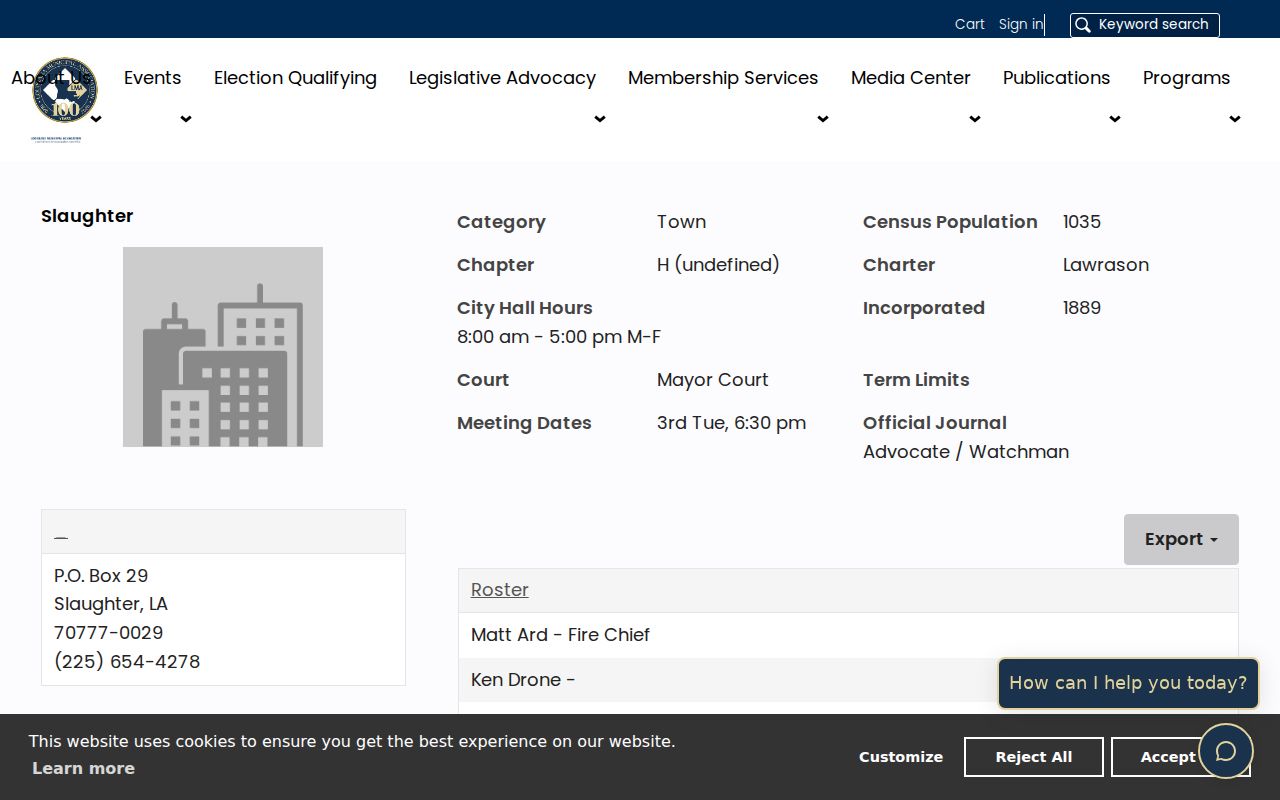
The profile helps explain Slaughter's municipal scale, while the parish-seat role explains why town and parish records should never be collapsed into one search.
The Slaughter Police Department
Slaughter Police Department is at 804 W. Railroad Avenue, Slaughter, Louisiana. The department can be reached at 225-654-2382 and research identifies Howard Henderson as chief. Town Hall is at 3337 Church Street, 225-654-4278, with clerk.org as the documented email. The department holds the reports it creates. Give a focused description, including the people involved, approximate date, location, and report number when known. A precise request is easier to route and makes redaction or partial release more practical.
No dedicated Slaughter police-report request form was verified. Louisiana criminal-history dissemination law also explains why BCII is not an unrestricted public people-search system.
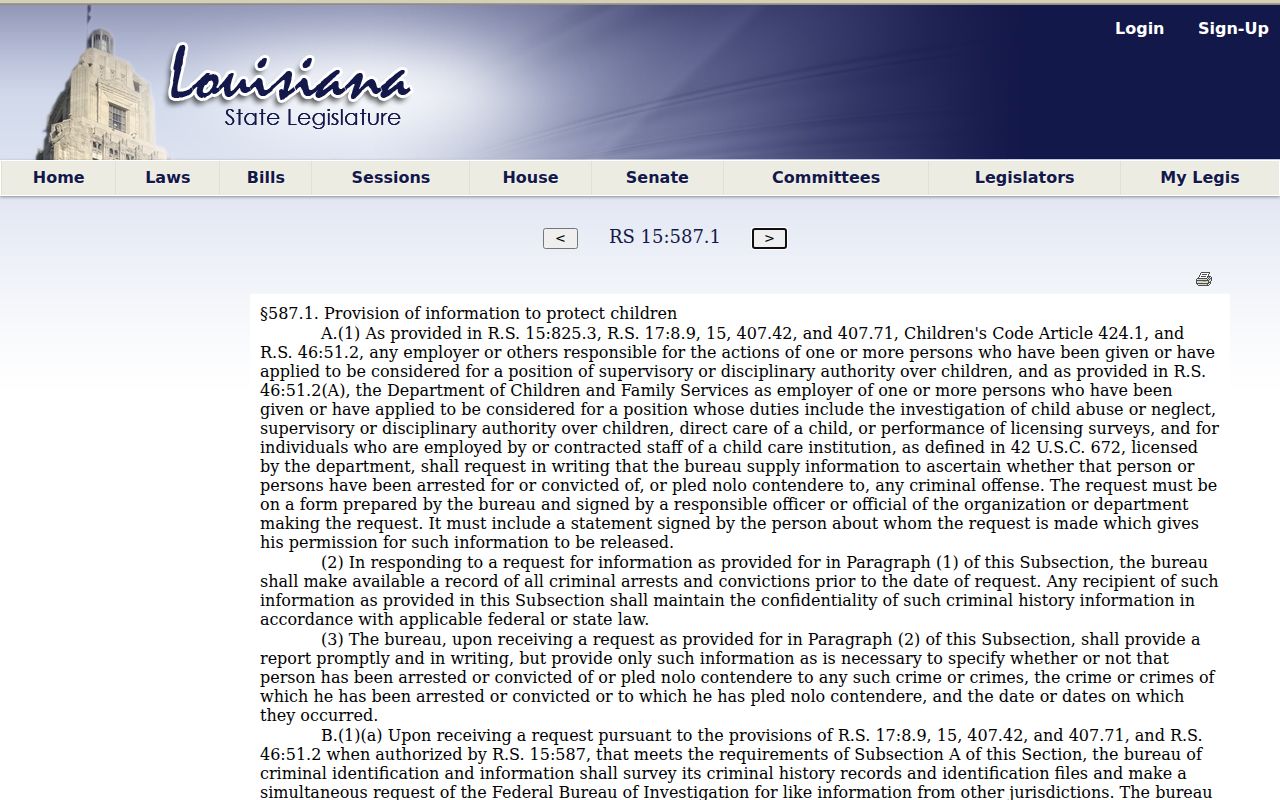
This official channel is the best fallback because no verified Slaughter arrest blotter, police app, or general police-report portal was located.
Three Custodians for Slaughter Arrests
Bank Street can cause confusion because Slaughter municipal offices and a sheriff community-awareness or registry function appear in the same general area. Sheriff headquarters is instead listed at 12224 Woodville Street, with 225-683-8572 as the main number. The 11315 Bank Street entry is associated with civil and registry community-awareness work, not a universal sheriff records counter. The jail is another distinct destination.
The badge or arrest location does not alone establish who keeps every document. Identify the arresting agency shown on the paperwork before sending a request.
Arrests and Bookings in Slaughter
A Slaughter arrest can produce several records on different schedules. The police report describes the encounter and alleged conduct. If the person is taken into custody, the East Feliciana Parish Jail creates booking and custody data. Call 225-683-3313 because no verified official public local roster was found. A booking confirms intake allegations and custody; it does not prove guilt or establish that the district attorney accepted every listed charge.
If a person is no longer at the jail, consider release, transfer, another jurisdiction, or a corrected booking name. LA VINE can help after transfer and is described by DPS&C as updating daily. For state custody, DPS&C can also be called at 225-383-4580 with a department number or a name and date of birth. The fuller county process appears on the East Feliciana Parish arrest history page.
Slaughter QuickCourt Boundaries
Slaughter's QuickCourt interface is useful only for a known ticket. It requests first and last name, address, city, state, ZIP code, and either a driver's-license number or ticket number. Those fields make it a payment and citation-location tool, not a public name-search criminal docket.
The official Slaughter QuickCourt portal illustrates that narrow function.
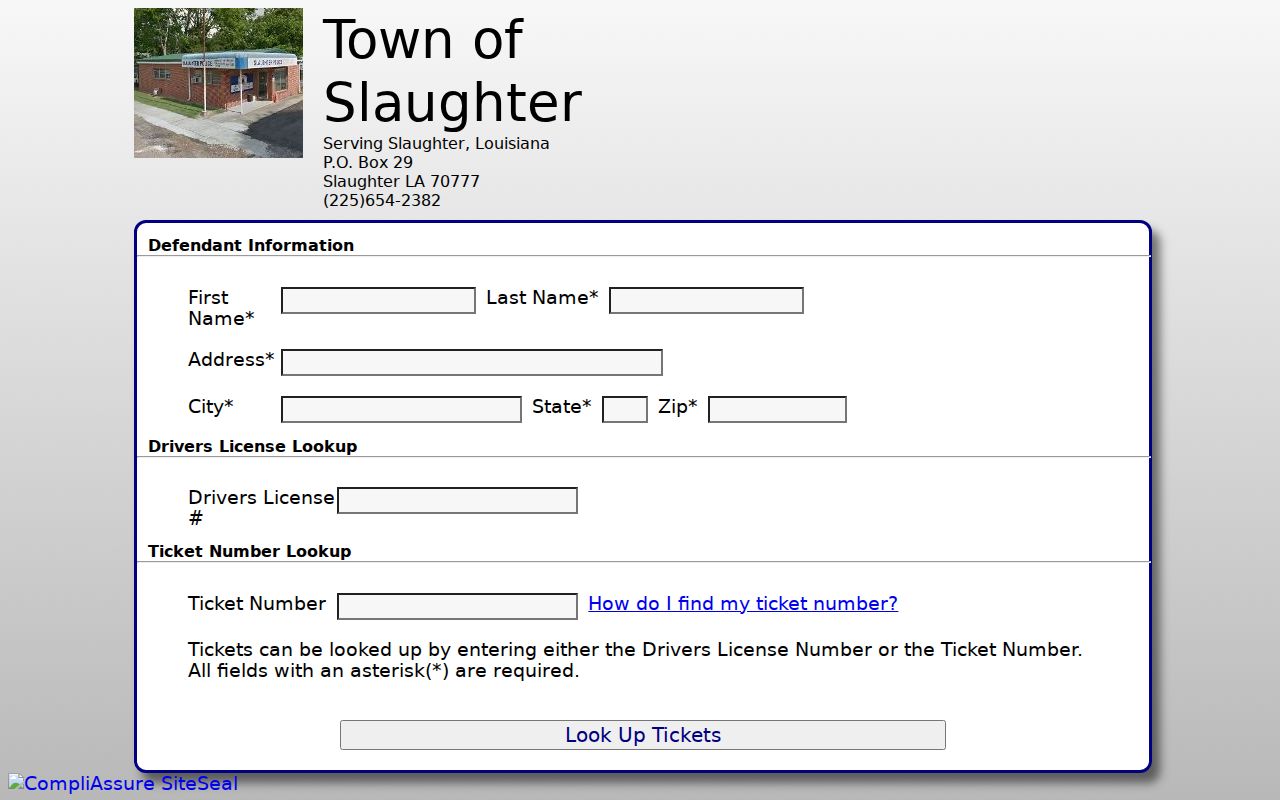
A no-result response does not establish that no Slaughter arrest, parish booking, or district-court case exists. Use the town court and appropriate record custodian for those questions.
Slaughter Municipal Court Records
Slaughter municipal matters may be handled through the town's Mayor's Court. These files are distinct from the 20th JDC criminal docket. A municipal citation need not become a district case, while an incident that leads to a state-law charge can move beyond the local court. Contact the town to confirm the correct court custodian and request a disposition, minute entry, or citation status.
| Court Name | Slaughter Mayor's Court or other town channel confirmed by Town Hall |
|---|---|
| Case Types Heard | Municipal ordinance and traffic matters within local authority |
| Case Lookup Channel | Town contact; QuickCourt for a known citation, not a general docket |
| What the Docket Shows | Citation, appearance, payment, warrant, and disposition information when maintained |
| Copies & Fees | Ask the town custodian for the current copy method and charge |
For a state-law filing, contact the clerk at 225-683-5145. Do not infer the court from the fact that an event occurred inside Slaughter.
Slaughter Cases Beyond Town Court
East Feliciana criminal cases belong to the 20th Judicial District Court at 12220 St. Helena Street, and the clerk's counter is at 12305 St. Helena Street. The district attorney is also the 20th Judicial District Attorney. Matching the court number before requesting a file prevents a Slaughter search from being routed to another Louisiana district.
The clerk counter is open Monday through Friday from 8:30 a.m. to 4:30 p.m. Published criminal fees include a $10 per-name parish background check, $1 per regular copy page, $5 for a certified copy, and $15 for an extract of minutes. Those products cover parish court records, not an unrestricted statewide people search.
Where Slaughter Records End Up
A report remains with the agency that created it. A custodial booking goes to the parish jail. When a prosecutor accepts a state-law charge, the resulting bill of information, indictment, motions, minutes, disposition, and sentence are maintained in the judicial file. Disposition information may later reach BCII through the Louisiana Computerized Criminal History system.
Record flow: Slaughter Police Department › East Feliciana Parish Jail › 20th Judicial District Court › Louisiana State Police BCII
The path is not instantaneous. If a recent arrest has no clerk case, allow for intake and charging lag, then ask using the approximate event date. If a state self-review lacks a disposition, obtain an original certified disposition from the clerk and follow BCII correction instructions.
Slaughter Right to Review
The Feliciana District probation and parole office is at 9508 Plank Road, Suite B, Clinton, with phone 225-683-5012 and weekday hours of 8:00 a.m. to 4:30 p.m. The state office supervises roughly 1,200 cases and works weekly at the 20th JDC. It administers current community supervision; it does not replace the sentencing minutes or a parole decision record.
The Right to Review statute authorizes a person to review state criminal-history information concerning that person.
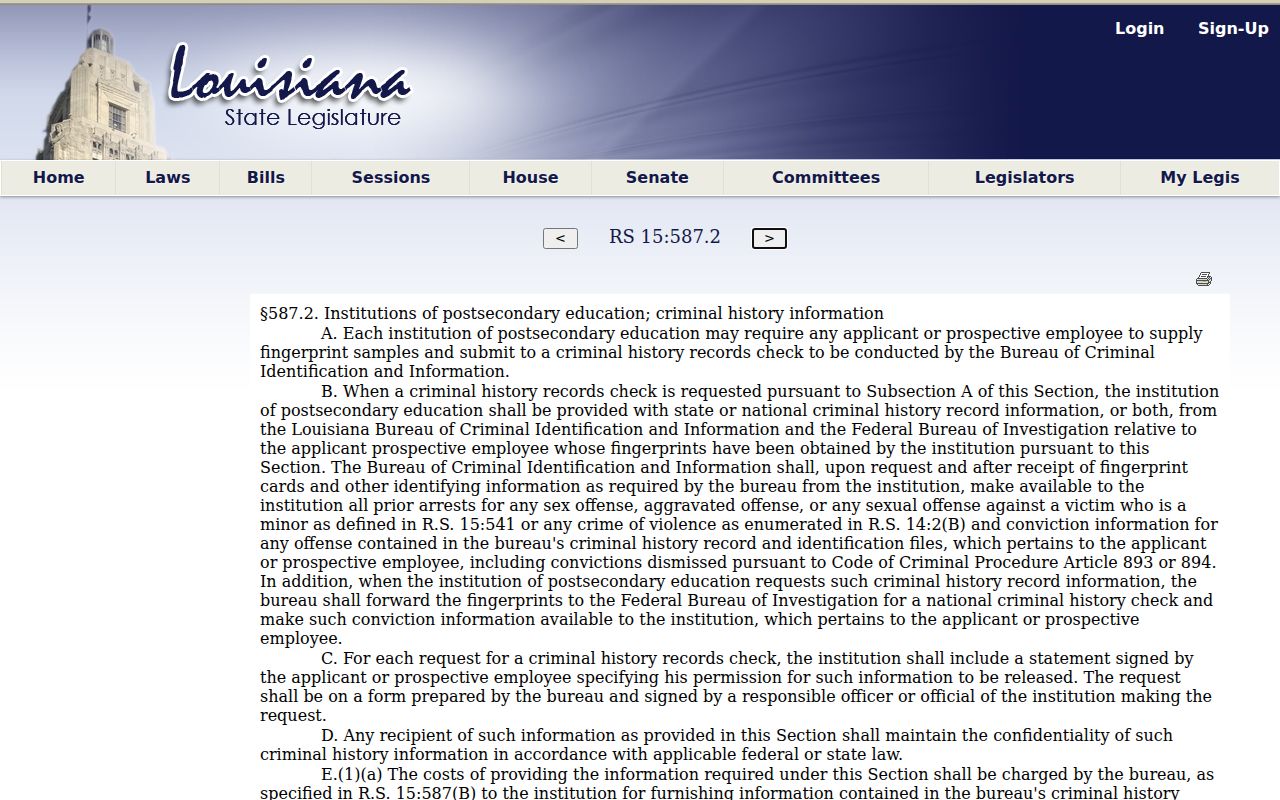
For a statewide self-review, follow the fingerprint channel documented by BCII. A parish clerk name check covers parish court files only, while Right to Review is identity based.
When Slaughter Has No Portal
When an online result is missing or too thin, call the clerk before traveling. Supply a full name, aliases, date of birth if appropriate, approximate filing or arrest date, and any docket number. Ask whether the file is available for inspection and which pages would prove the needed disposition. Louisiana Code of Civil Procedure article 251 generally permits examination and copying during open hours, subject to restrictions.
Do not assume a phone may be used to scan the file. Article 251 restricts privately owned scanning or copying equipment in a clerk's office absent a court order. Ordering the specific minute entry, disposition, or certified copy can be more useful than copying an entire file.
Public Access Rules
Louisiana Public Records Law starts with the custodian. Town police, Mayor's Court, EFPSO, the jail, and the district clerk are separate public bodies or custodians for different records. Request inspection or reasonably segregated nonexempt portions if a full report cannot be released. If access is denied, ask for the precise statutory basis in writing.
- La. R.S. 44:1 defines public records, public bodies, and custodians.
- La. R.S. 44:3 addresses law-enforcement and investigatory exceptions.
- La. R.S. 15:587 controls criminal-history dissemination by BCII.
- La. R.S. 15:588 authorizes personal review of one's state record.
- C.Cr.P. art. 973 makes expunged records confidential while preserving specified access.
Active-investigation material, juvenile information, victim-identifying details, sealed records, and expunged records may be withheld or redacted. Public availability never authorizes harassment, threats, or retaliation.
Slaughter Charges Can Change
Compare records by identifiers, not merely by name. Match the arrest date, arresting agency, report or booking number, every original charge, amendments, the filed charge, outcome, and sentence. A booking allegation may change or disappear before filing. A citation payment screen may omit the municipal court's later disposition. A court result may take time to reach LACCH.
For correction of a person's own Louisiana history, obtain BCII Right to Review fingerprints and an original, unaltered certified court disposition. The clerk, district attorney, or city prosecutor may need to supply information missing from the state file. That sequence is more dependable than treating any single Slaughter screen as complete.